
UBA Pressure Washing
& Sealer · Sarasota, FL
(941) 320‑6172
Free Quote →
Sealing pays for itself on some Florida paver surfaces and is close to a waste on others. Here’s how to tell which you have, and how often to seal pavers once you decide to.
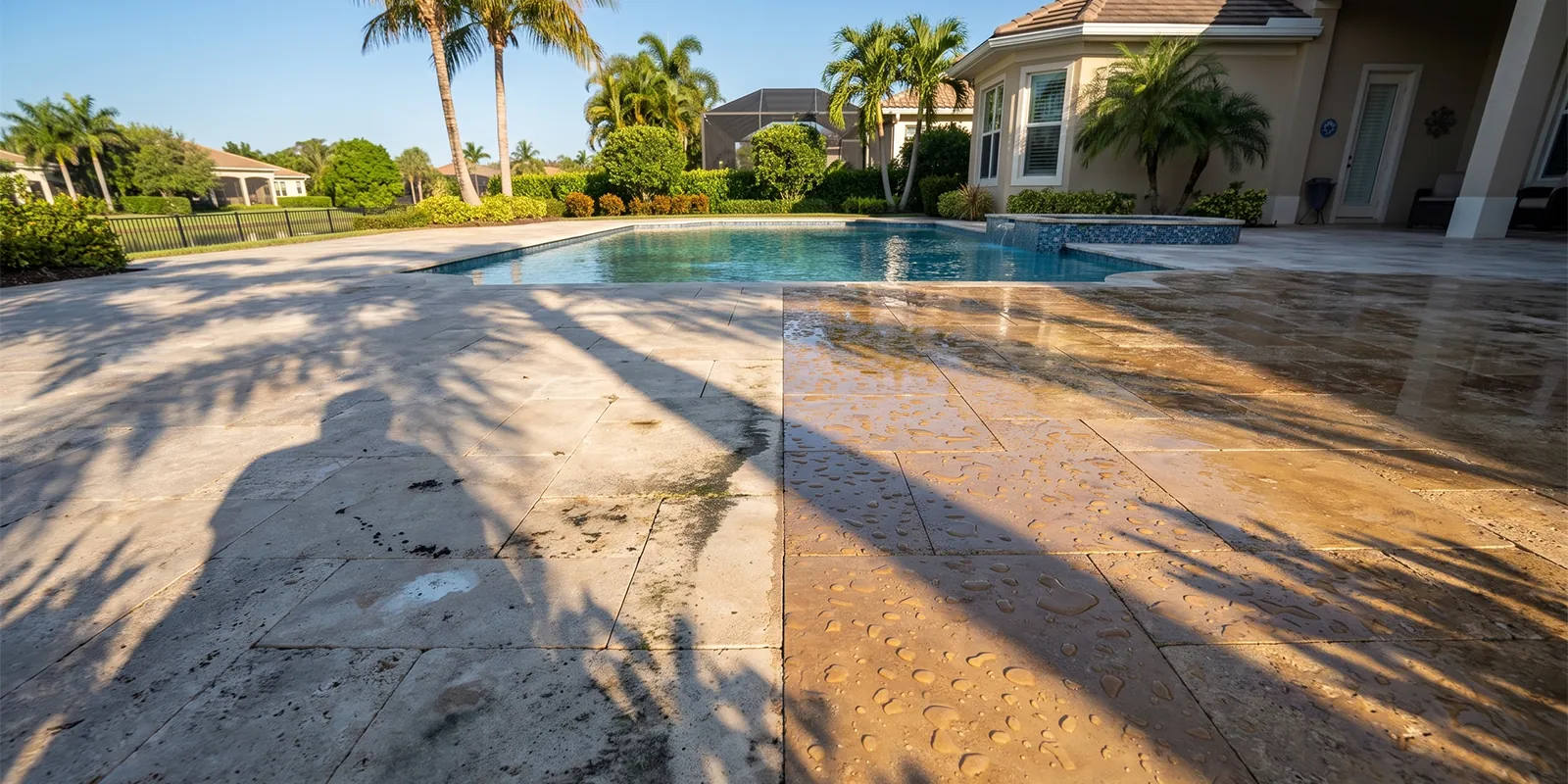
Most homeowners arrive at this question after a contractor has already told them the answer is yes, so it’s worth saying plainly that sealing is not universal. It’s a maintenance decision with real tradeoffs, and the surfaces where it pays off are specific enough that you can usually sort your own property in about two minutes.
Travertine, marble, shell, and any other natural stone belong in the seal column without much debate, since porous stone absorbs sunscreen, pool chemicals, and organic staining that no amount of later cleaning fully lifts. Concrete pavers in direct sun belong there too, because UV fade on a driveway is permanent in a way that dirt never is. Add any surface where spills are routine, so pool decks, outdoor kitchens, grill patios, and the strip of driveway where a car actually parks.
A shaded concrete paver walkway on the north side of a house, a rarely used side path, a courtyard under heavy tree cover: these hold their color for years on their own, and sealing them buys mostly peace of mind. Permeable pavers are their own case, because they were installed specifically to let water through, and sealing them wrong undoes the reason they exist. If the surface is dense, shaded, and not somewhere anyone eats or parks, the honest answer is that cleaning it every year or two is enough.
In Florida, plan on a full reseal every 3 to 5 years, with a lighter maintenance recoat around year 3 that stretches the protection envelope out to year 6 or 7. Drier climates get 7 to 10 years out of the same products, so any timeline you read on a national manufacturer’s site is describing a condition Florida doesn’t offer. The rest of this guide breaks that interval down by material, explains what shortens it, and covers the four signs that tell you the interval has run out early.
Almost every article on this topic lists the benefits of sealing and stops there, which makes the decision look obvious and leaves homeowners surprised later. Sealing has real costs, and the honest version of this comparison includes both columns.
| Sealed | Unsealed | |
|---|---|---|
| Color retention in direct sun | Holds original tone for years | Visible fade in 12 to 24 months |
| Stain resistance (oil, sunscreen, food) | High, most spills wipe up | Low, porous surface absorbs |
| Joint sand retention | Sand binds in the upper joint | Washes out in heavy summer rain |
| Biological growth | Nothing for algae to anchor to | Black streaking and moss take hold |
| Slip resistance when wet | Depends entirely on product choice | Natural texture, but algae makes it slick |
| Water permeability | Reduced, and a real problem on permeable pavers | Full |
| Maintenance commitment | Recurring, every 3 to 5 years | Cleaning only, no cycle to maintain |
| Reversibility | Hard, failed sealer must be stripped | Nothing to undo |
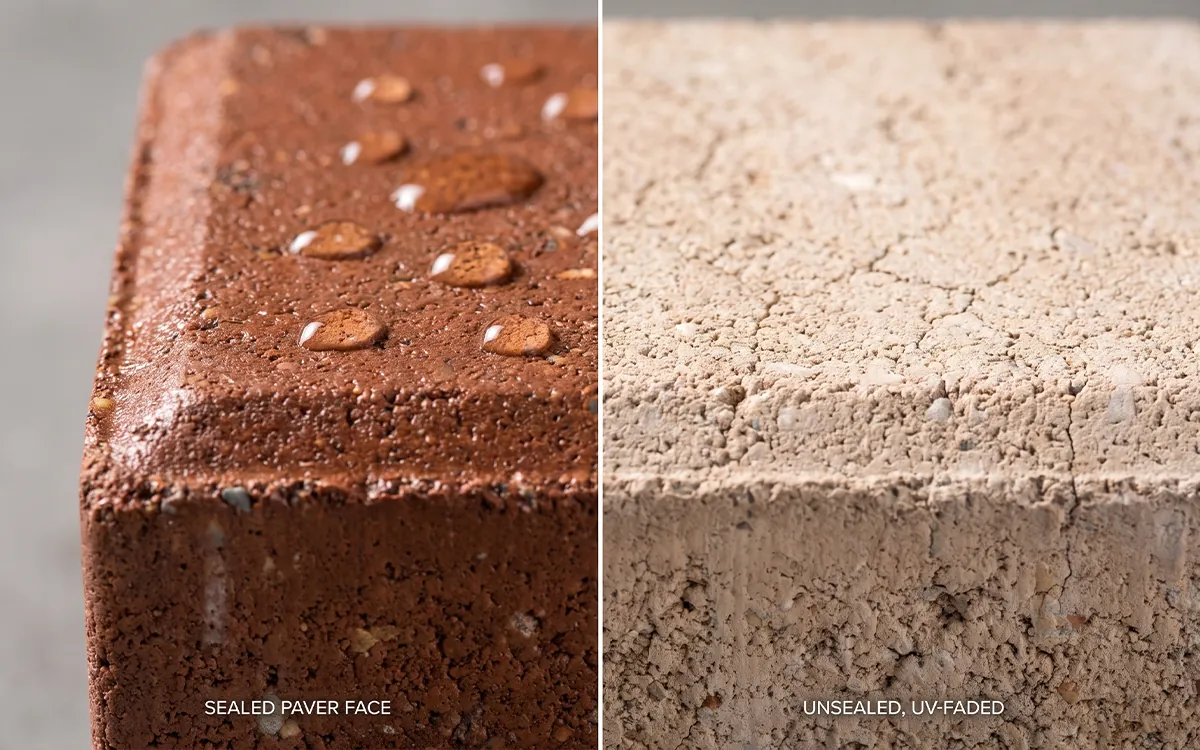
The single biggest return is color, because UV fade is the one form of paver damage that cleaning can’t reverse. A sealed concrete paver driveway looks close to installation-day color at year 4, while its unsealed neighbor has gone chalky and flat by year 2, and that difference shows in an appraisal and in a buyer’s first impression. Stain resistance is the second return and it’s the one homeowners notice day to day, since a sealed surface gives you a window to wipe up dropped sunscreen or grill grease before it becomes permanent.
You’re signing up for a cycle. Once a surface is sealed, letting the sealer fail without recoating looks worse than never sealing at all, because failed sealer goes patchy, cloudy, or white-hazy instead of fading evenly. Stripping a failed sealer is significantly more labor than a fresh application, so the homeowner who seals once and then ignores it for eight years ends up paying more than the one who never started. That’s the part that gets left out of most sales conversations, and it’s the reason a decision guide is worth reading before a quote.
Permeable pavers, including the shell lock installations common along the Gulf Coast, exist to let stormwater infiltrate rather than run off, and some Florida communities count that infiltration toward drainage requirements. Sealing the joints on a permeable system defeats it, and the University of Florida IFAS Extension publishes guidance on permeable hardscape performance worth reading before touching one. There’s a middle path where the visible paver faces get sealed and the joints are left open, but it’s a job that requires someone who understands what the system was installed to do.
Run your own surface down the left column and count how many rows you actually care about. A pool deck in full sun scores high on color, stains, growth, and slip, which makes it an easy yes. A shaded back walkway scores on almost nothing, which makes it an easy no. The surfaces that land in the middle, usually a partly shaded driveway or a covered lanai, are the ones worth a conversation with someone who’ll look at them in person rather than quote from a satellite image.
These are the same five things a crew lead walks through on a Sarasota assessment, in the order they matter. Answer them honestly and the decision usually makes itself.
Natural stone (travertine, marble, shell) is porous, which means it absorbs rather than repels, and sealing it is closer to necessary than optional. Concrete pavers are denser and the case is weaker, though it strengthens fast in direct sun. Clay brick pavers sit in between, holding color better than concrete but staining more readily. If you don’t know what you have, a wet fingertip on an inconspicuous spot tells you a lot: stone that darkens instantly and stays dark for a minute is porous enough to be worth sealing.
Sun exposure is the variable that moves this decision more than any other in Florida. A surface that takes six or more hours of direct sun will fade visibly inside two years, and that fade is permanent short of a color-enhancing sealer applied later at greater cost. A surface under a lanai roof or heavy canopy is a different question entirely, since its main enemy is biological growth, which cleaning handles.
Ask what actually lands on the surface in a normal month. Sunscreen and body oils on a pool deck, grease from a grill, dropped food on a patio, engine drips and tire marks on a driveway, fallen citrus and fertilizer runoff in a courtyard: each of those stains porous paver differently and each is far easier to clean off a sealed surface. A walkway that only ever sees shoes and rain has almost none of this exposure, which is exactly why it lands in the skip column.
This one gets skipped and it shouldn’t. Sealing is a multi-year commitment to a recoat cycle, so if you’re selling inside a year, a thorough professional cleaning delivers most of the visual result without signing the next owner up for a maintenance schedule they don’t know about. If you’re staying five years or more, the math flips, because you’ll live through two or three fade cycles on an unsealed surface and you’ll be paying to clean it repeatedly either way.
Sealer locks in whatever is underneath it, so a surface with active efflorescence, embedded oil, or a failing prior sealer isn’t ready. Brand new pavers aren’t ready either, because concrete needs time to finish curing and releasing its own mineral bloom before anything goes over the top. Neither of these is a permanent no, and both change what the first appointment should be.
Interval guidance from national manufacturers assumes a moderate climate, and Florida compresses every one of those numbers. Sun, humidity, salt air, and year-round biological growth pressure all shorten sealer life, so here’s how often to seal pavers by material with the Florida correction already applied.
| Material | Florida full-reseal interval | Milder-climate interval | What shortens it fastest |
|---|---|---|---|
| Concrete pavers | 3 to 5 years | 5 to 7 years | Direct sun, vehicle traffic, joint sand loss |
| Travertine and natural stone | 2 to 4 years | 4 to 6 years | Pool chemicals, sunscreen, salt air |
| Marble | 2 to 4 years | 4 to 6 years | Acidic exposure (pool chemicals, citrus, fertilizer) |
| Clay brick | 4 to 6 years | 6 to 8 years | Sun exposure, freeze-thaw (rare in Florida) |
| Permeable / shell lock | Case by case, often not at all | Case by case | Sealing wrong destroys infiltration |
Four things stack here and they compound rather than add. UV load is high year-round instead of seasonal, humidity keeps porous surfaces damp long enough for organisms to establish, salt air reaches properties well inland from the Gulf and pulls moisture into the surface, and summer storms that drop two inches in an hour strip joint sand and drive water into anything with an open pore. A sealer engineered for a national average is being asked to do more work here, and it wears out proportionally faster.
The most useful thing in this entire guide is probably the recoat, because it’s the step most homeowners never hear about. A light maintenance coat applied around year 3, while the original sealer is still largely intact, costs a fraction of a full strip-and-reseal and pushes the surface out to year 6 or 7 before it needs the full job. Skip it and you’re not saving money, you’re deferring a bigger bill, since the year 5 surface needs a complete clean, re-sand, dry, and two-coat application.
The intervals above assume normal residential use, and a driveway that parks two vehicles daily wears through sealer in the tire paths years before the untraveled edges show anything. A pool deck that hosts a family every weekend runs through sealer faster than one that’s mostly decorative. Rather than resealing the whole surface on a calendar, it’s often smarter to recoat the high-wear zones on the shorter interval and the rest on the longer one, which is a normal request and one a competent crew should be willing to quote.
Sealer datasheets quote lifespan under laboratory or moderate-climate conditions with a correctly prepped substrate and a full two-coat application, none of which describes a rushed job on a damp surface. The Interlocking Concrete Pavement Institute publishes the maintenance and installation standards those numbers assume, and the gap between the datasheet and real Florida performance is almost always a prep gap rather than a product gap.
How often to seal pavers is a planning question, and the surface itself is the authority that overrides whatever the calendar says. Any one of these four signs means the sealer has stopped working, whether that lands at year 2 or year 6.
Pour a cup of water on the surface and watch it for thirty seconds. Sealed paver holds the water in distinct beads that sit on top; failing sealer lets it flatten and spread; failed sealer lets it darken the paver as it soaks in. Test a high-traffic spot and a protected spot, because the difference between them tells you whether you need a full reseal or just a recoat on the worn zone.
Sealed pavers hold a slight depth of tone even in matte finishes, and the first thing to go as the sealer thins is that depth. Compare an exposed section against a section that’s been under a planter or a doormat, since that protected patch is a preserved sample of what the surface is supposed to look like. A visible gap between the two is the clearest color evidence you’ll get.
Run a finger along a few joints. Sand that sits flush with the paver top is doing its job, while sand that has receded a quarter inch or more is being carried off by rain, and once the joint drops far enough the pavers start rocking underfoot. Joint sand loss and sealer failure travel together, because the sealer is what was binding the top of that sand in place.
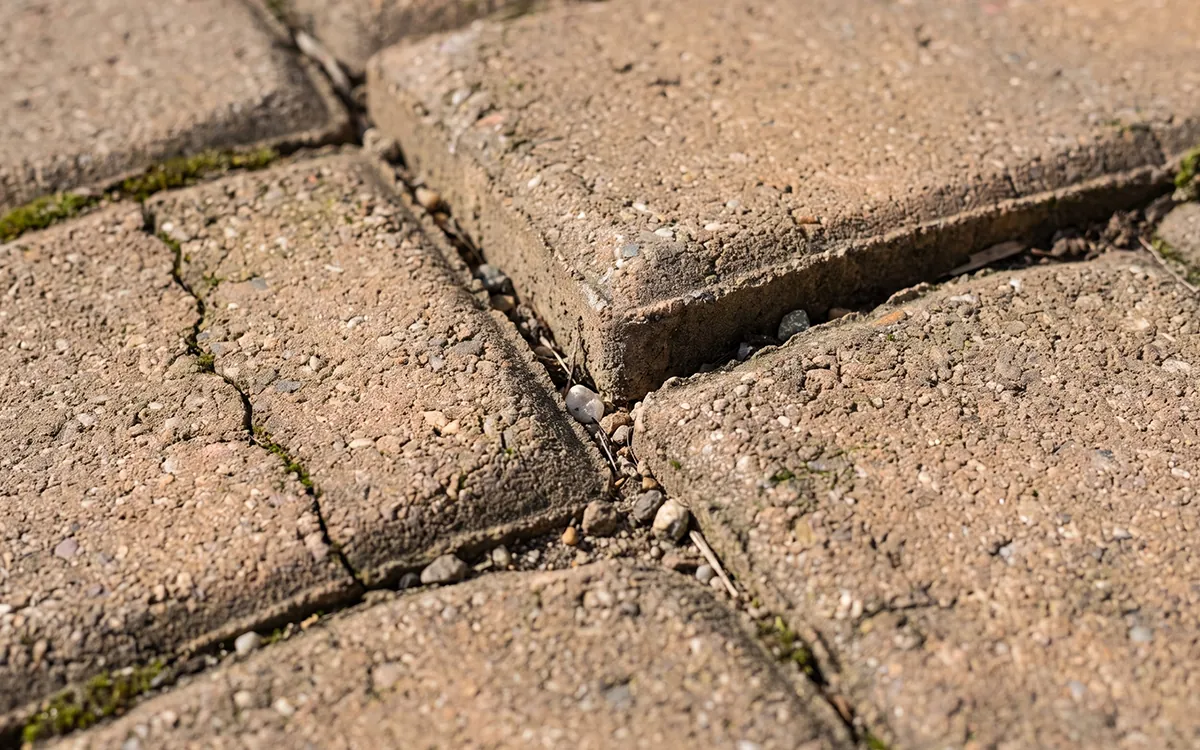
A cleaned surface that streaks or greens again within a few months is telling you there’s nothing left to stop it. Biological growth needs porosity to anchor in, so quick regrowth after a proper cleaning is direct evidence the pore structure is open again. This one is easy to misread as a cleaning problem, and homeowners often book a second cleaning when the surface actually needs sealing.
Timing matters as much as the decision itself, and each of these is a reason to wait rather than a reason to never seal.
New concrete pavers keep curing after installation and push mineral salts to the surface as they do, which is the white bloom called efflorescence. Sealing over that traps it permanently under the coating. Most installers want 60 to 90 days before anything goes on top, and letting a first rainy season pass is the more conservative call in Florida.
Sealer locks in whatever it covers, so residual algae, embedded oil, or trapped moisture all become permanent once a coat goes over them. In Sarasota humidity, a properly cleaned surface needs 24 to 48 hours of dry weather before sealer touches it, which is why a crew willing to clean and seal in a single afternoon is a warning rather than a convenience. Sealing damp paver produces white blushing that only comes off by stripping the coat and starting over.
Applying a new sealer over an incompatible old one is one of the more expensive mistakes in this category, because solvent-based products can lift and cloud water-based coats underneath and the resulting mess has to be stripped completely. If a surface has been sealed before and nobody knows with what, a small test patch in an inconspicuous corner settles it in a day. That test is cheap and skipping it is not.
Permeable and shell lock installations were often specified to satisfy a stormwater or drainage requirement, and sealing the joints closed can undo compliance the homeowner doesn’t realize they’re carrying. Face-only sealing is sometimes viable and sometimes not. Anyone who quotes a permeable system the same way they’d quote a standard concrete driveway hasn’t understood what’s in front of them.
UBA cleans and seals travertine, marble, shell lock, and concrete brick pavers across Sarasota and Manatee counties, and paver work accounts for roughly a fifth of the company’s volume. The assessment exists to answer the two questions this guide has been asking, whether your surface should be sealed at all and how often to seal pavers like yours, on your specific property.
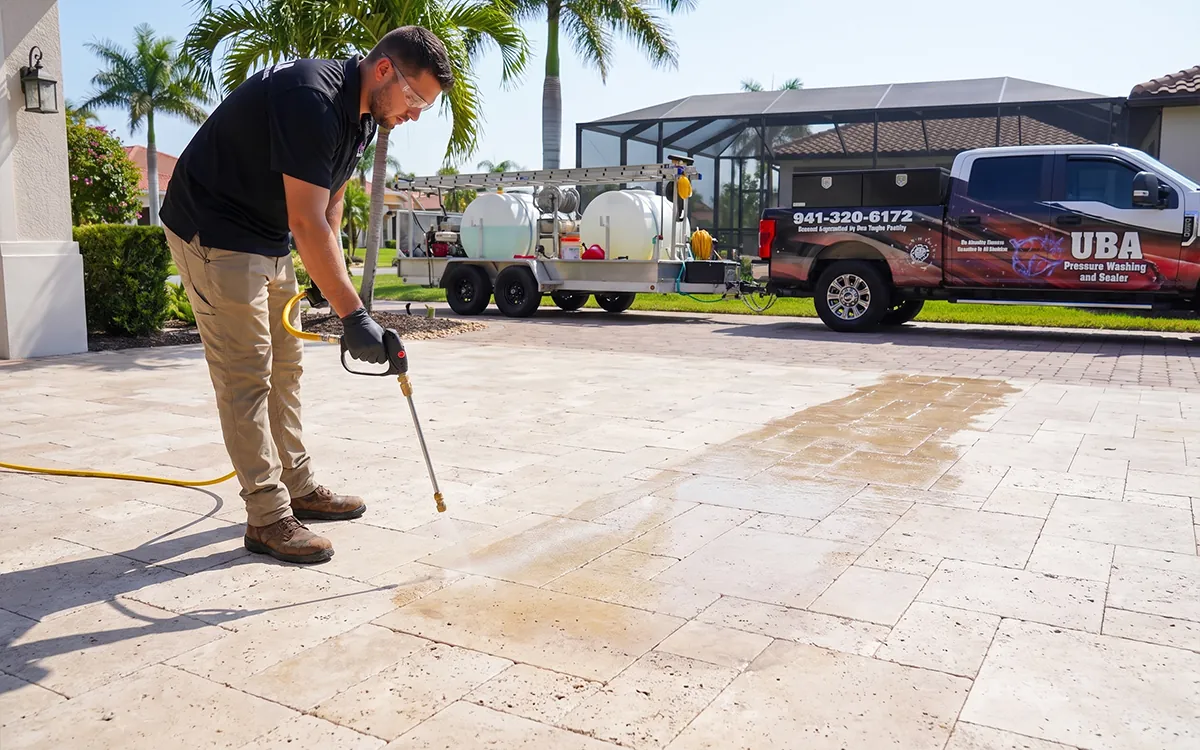
No sealer gets selected before a crew lead has walked the property, identified each paver type, checked for prior applications, and asked what you want the finished surface to look like. Penetrating products protect from within and preserve the untreated look, while topical and solvent-based products enrich color and add sheen, and those are genuinely different outcomes rather than tiers of the same thing. Anyone quoting a paver sealing job over the phone without seeing it is guessing at the two variables that matter most. The full breakdown of UBA’s paver cleaning and sealing process covers the chemistry, the joint sand approach, and the cure sequence in detail.
Paver sealing cost moves with material, square footage, current condition, how much joint sand has to be replaced, which sealer the finish calls for, and how accessible the surface is, so a single posted number would mislead most of the people reading it. A 400 square foot shaded concrete walkway and a 2,000 square foot travertine pool deck are not the same job in any dimension. The number you get comes after someone has walked the surface, and it’s the number you pay, with no mid-job additions once work has started.
Some assessments end with a recommendation against sealing, usually on a shaded low-traffic surface where a thorough clean gets nearly the same result without starting a recoat cycle, or on a permeable system where sealing would compromise what it was installed to do. Turning down work is easier to justify than talking someone into a maintenance commitment they don’t need, and it’s the reason this guide reads the way it does. For natural stone care standards behind the porous-surface recommendation, the Natural Stone Institute is the reference the trade uses.
Prefer to talk it through first? Call (941) 320-6172 and describe the surface.
Not universally. Porous natural stone and any paver in heavy direct sun benefit enough to make it worthwhile, while a shaded, low-traffic concrete walkway does fine on cleaning alone.
Every 3 to 5 years for a full reseal on most concrete pavers, and every 2 to 4 years on travertine, marble, and other natural stone. A lighter maintenance recoat around year 3 extends either interval out to roughly year 6 or 7. Florida’s UV load, humidity, salt air, and year-round growth pressure compress these numbers compared to the intervals printed on national product datasheets.
They fade, they stain more readily, they lose joint sand faster in heavy rain, and biological growth establishes in the open pore structure. None of that is structural failure, and on a shaded low-use surface it may never bother you. On a sun-exposed driveway or pool deck, the color loss becomes permanent within about two years, and that’s the part cleaning can’t undo later.
You can, and the two steps that most often go wrong are the ones that don’t look like steps: cleaning to a genuinely bare surface, and waiting for it to fully dry before anything goes on. Rushing either produces patchy coverage or white blushing that has to be stripped and redone, which is how a weekend project becomes a professional remediation.
It can, depending entirely on the product. Standard penetrating sealers leave travertine slicker than it was when wet, which is why a slip-resistant top layer belongs on any pool deck, lanai, or walkway that gets wet routinely. That layer adds a micro-texture without changing the visual finish.
No. New concrete needs 60 to 90 days to finish curing and push out its efflorescence, and sealing over that bloom traps it under the coating for good.
Usually yes, but the prior sealer has to be identified first. If it’s the same chemistry and still intact, a maintenance recoat goes on straightforwardly. If it’s a different chemistry, has failed, or has hazed white, it has to be stripped before anything new is applied, and stripping a failed topical sealer is considerably more labor than sealing a bare surface. A test patch in a hidden corner answers this in a day.
Partly. Sealer binds the top of the joint sand, which makes it harder for windblown seed to settle and root, though it isn’t a herbicide and persistent weeds in a wet shaded joint will still find a way.
Bring us your surface and we’ll walk it with you, tell you honestly whether it needs sealing, and if it does, how often to plan on doing it again.