
UBA Pressure Washing
& Sealer · Sarasota, FL
(941) 320‑6172
Free Quote →
Polymeric sand and paver sealer solve two different problems, so the polymeric sand vs sealer question is really about which sand belongs under your sealer. Here is the straight answer for Florida.
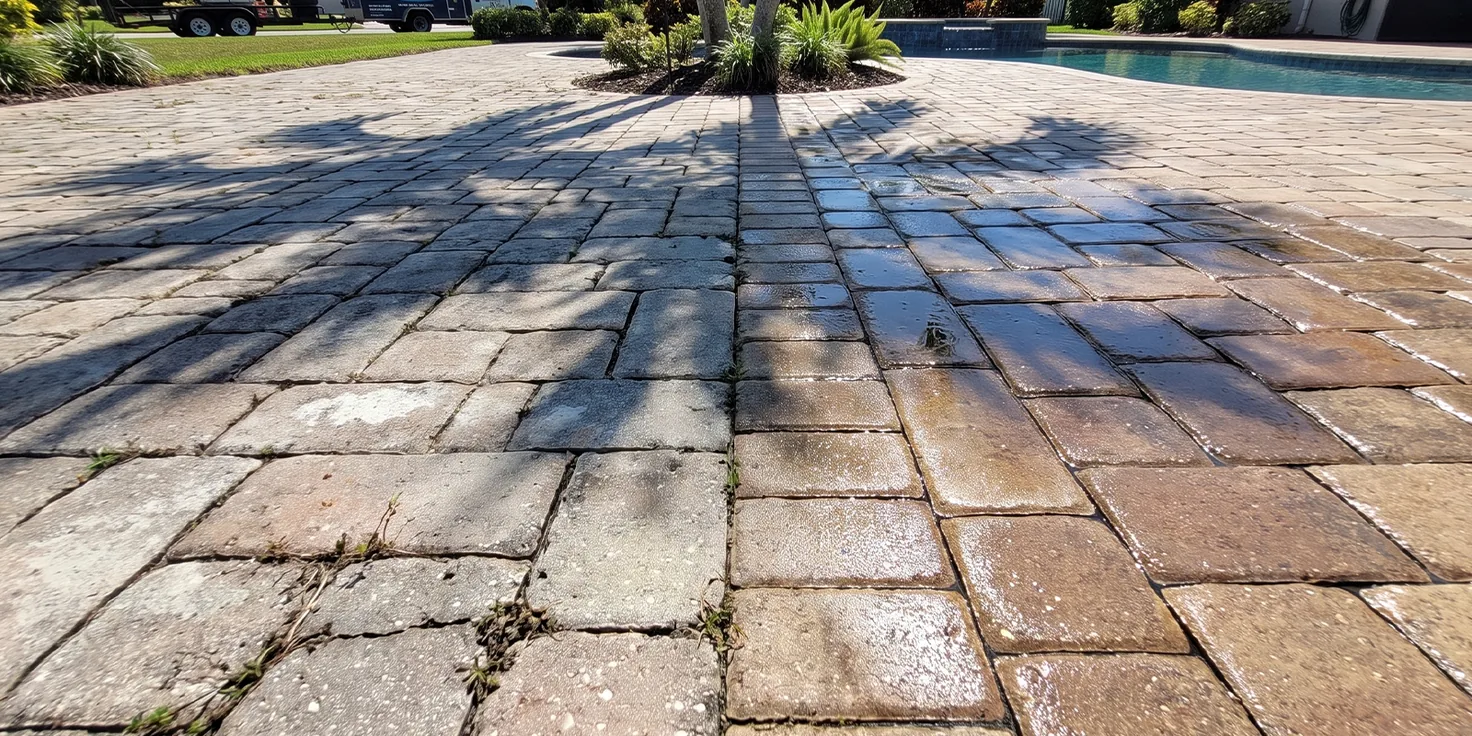
Joint sand holds your pavers in place and sealer protects the surface, so the polymeric sand vs sealer decision is rarely a straight either/or. Every working paver surface already has sand in the joints, which makes the real choice whether that sand is polymeric or polymer free, and whether a sealer goes over it. On the Sarasota and Manatee installations we walk every week the answer is polymer-free sand under a joint-stabilizing sealer.
Interlocking pavement works because the joints are full. Sand transfers load sideways from one paver to the next, which keeps a driveway from rutting under a car and a pool deck from rocking underfoot. Lose the sand and you lose that interlock, and the pavers start moving independently while the bedding course washes out from underneath.
A paver sealer sits on the surface and just inside the top of the joint, where it blocks stains, slows the UV fade that dulls paver color, and makes organic growth easier to wash off. The joint-stabilizing formulations do one more thing: they penetrate the upper layer of sand and lock it down mechanically. That last job is why this choice is not the coin flip it looks like.
Once you know the sealer is already stabilizing the joint, the question becomes which sand you want sitting under it for the next several years. Both kinds fill the joint and hold the pavers apart. They differ in how they behave once Florida weather gets into them, and much more in what it costs to put right when they fail.
These two products get compared constantly because both claim to stabilize a joint. The table separates what each one does from what it gets credit for.
| Polymeric Sand | Paver Sealer | |
|---|---|---|
| Where it sits | Inside the joint, full depth | On the surface and the top of the joint |
| What it is | Silica sand plus a water-activated polymer binder | Acrylic, urethane, or penetrating silane and siloxane coating |
| Primary job | Joint stabilization, weed and insect resistance | Stain resistance, UV color retention, easier cleaning |
| Stabilizes joint sand | Yes, by hardening the full depth of the joint | Yes, joint-stabilizing formulas bind the top layer |
| Install requirement | Dry sand, dry joint, staged water activation, about 24 hours without rain | Clean dry surface with efflorescence removed, 24 to 48 hour cure |
| Florida service life | 2 to 5 years before joint cracking or washout shows | 3 to 5 years before a maintenance recoat |
| How it fails | Cracks, partial washout, polymer residue locked into the joint | Wears thin and dulls, then recoats over itself |
| Cost to correct | Mechanical removal of the joint, then re-sand and reseal | Clean and recoat |
| Hazing risk on paver faces | Real, when activation water carries binder onto the surface | Low, it goes on the face deliberately |
This is the line that decides the argument. Polymer-free sand washed out after a heavy season is a bag of sand, a broom, and an hour of somebody’s afternoon. Failed polymeric sand is a removal job, because the hardened material has to come out of the joint mechanically first, and the residue left on the joint walls keeps fresh sand from settling and sealer from penetrating.
A sealer holds its stain and UV performance for 3 to 5 years here, and the maintenance recoat goes straight over the existing film after a clean. Polymeric sand in the same conditions starts cracking or washing out between year 2 and year 5, and the range is that wide because it depends on the weather during the week it went in.
Neither product corrects a base problem, so if the bedding course is thin, uncompacted, or washing out at an unsupported edge, the pavers keep moving and the joint keeps opening no matter what fills it. Neither one ends weeds permanently either, because windblown seed germinates in the debris on top of a joint rather than down in the sand. And sealing over efflorescence locks the chalky haze in rather than removing it.
The polymeric sand vs sealer answer changes by surface, so here is the decision laid out that way.
There is no working paver installation with empty joints, so sand is a given on a driveway, a pool deck, a lanai floor, a front walk, and a patio alike. If your joints sit low, gape open, or grow weeds down their length, sand is the first fix and it comes before any sealer conversation. On a shaded front walk, walkway cleaning comes first.
Anything taking sun, tire traffic, pool chemistry, sunscreen, grill grease, or shade-driven growth pays its sealer back in stain resistance and color retention. Concrete pavers are the clearest case, since they are porous and their pigment fades measurably under Florida UV, and travertine and marble come next because both are soft and absorb oils quickly. Surface-by-surface detail lives on the paver cleaning and sealing page.
Once a joint-stabilizing sealer is going on, polymeric sand sells you joint stability you are already paying for and attaches the harder failure mode to it. On residential driveways, pool decks, walkways, and patios across Sarasota and Manatee we fill the joints with polymer-free sand and let the sealer bind it, the same recommendation that sits on our paver sealing page.
Polymeric sand under a film-forming sealer, on a surface that holds water, is the pairing behind most of the repair calls we take. Water that gets past a cracked polymer joint has a film over the top of it and little route back out, so it sits in the bedding course, keeps the joint damp, and speeds up both the cracking and the growth coming back.
Polymeric sand is a good product in a moderate climate with a predictable install window. Sarasota hands you neither, and each of the four reasons below has cost a homeowner we have met real money.
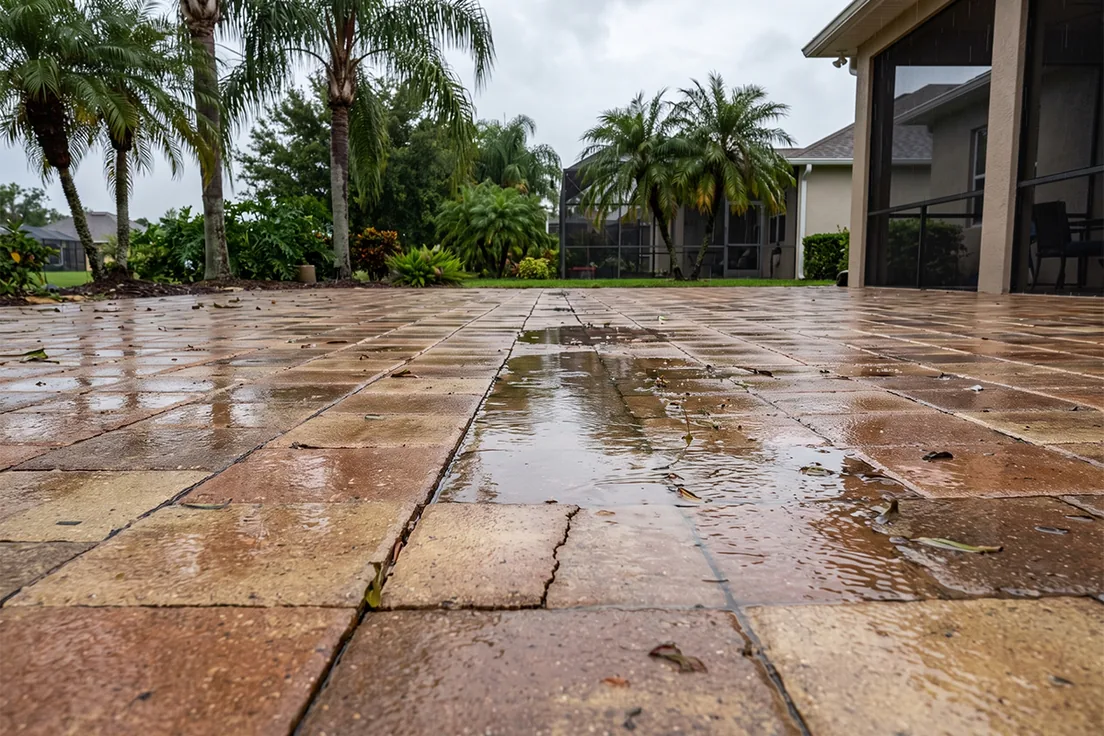
Polymeric sand needs dry sand going into a dry joint, a staged water activation, and roughly 24 hours without rain while the binder sets. From June through September the afternoon storm pattern and the overnight dew point routinely take that window away, and a joint rained on before the binder cures loses its polymers down the drain. We reschedule paver work whenever rain probability crosses 30 percent.
Interlocking pavement is a flexible system by design, so the surface moves slightly with the base and settles back. Florida bases move more than most: sand subgrades, irrigation cycles, root intrusion from mature landscaping, and a seasonal water table all shift the bedding course through the year, and UF/IFAS Extension documents how much those factors move Florida soils. A semi-rigid polymer joint on top of that movement cracks along its length.
Because polymeric sand activates with water, the binder travels wherever that water goes. If the paver faces are not cleared thoroughly first, the binder dries as a film across the surface that is visible from standing height and will not come off with a normal wash. The standard correction is an acid wash, a genuine risk on travertine, marble, shell lock, and any color-treated paver.
A partly failed polymer joint has to come out before the surface can be re-sanded and resealed, and removal means chipping, grinding, or blowing hardened material out of every joint. What stays behind is residue coating the joint walls, which is why fresh sand will not settle properly and sealer will not penetrate properly. The homeowner ends up paying for a demolition step nobody quoted them.
Our joint specification is deliberately simple, and simple is the entire point of it.
We fill the joints with traditional polymer-free joint sand as part of sealing prep, then apply the sealer, which penetrates the upper portion of the joint and binds that sand mechanically. The joint ends up stabilized against washout and foot traffic while staying loose enough underneath to move with the base and let water pass. The Concrete Masonry and Hardscapes Association, which absorbed the Interlocking Concrete Pavement Institute, documents joint sand and sealer interaction in terms that match our spec.
Joints give up some sand over a few Florida seasons whatever is in them, and with polymer-free sand that stays small and scheduled: sweep in fresh sand, compact it, recoat if the sealer is due anyway. It rides along with the 3 to 5 year recoat instead of becoming its own project.
We are not against the product on principle, and there are installations where it is the right call: high-traffic commercial hardscape on a predictable maintenance schedule, pedestrian-only surfaces under permanent cover where the joint stays dry, and new installs where the installer controls the base, the compaction, and a real dry-season window. Those conditions are uncommon on the residential properties we work on, which is why our recommendation stays put.
Three checks you can run yourself in about five minutes, before anybody quotes you anything.
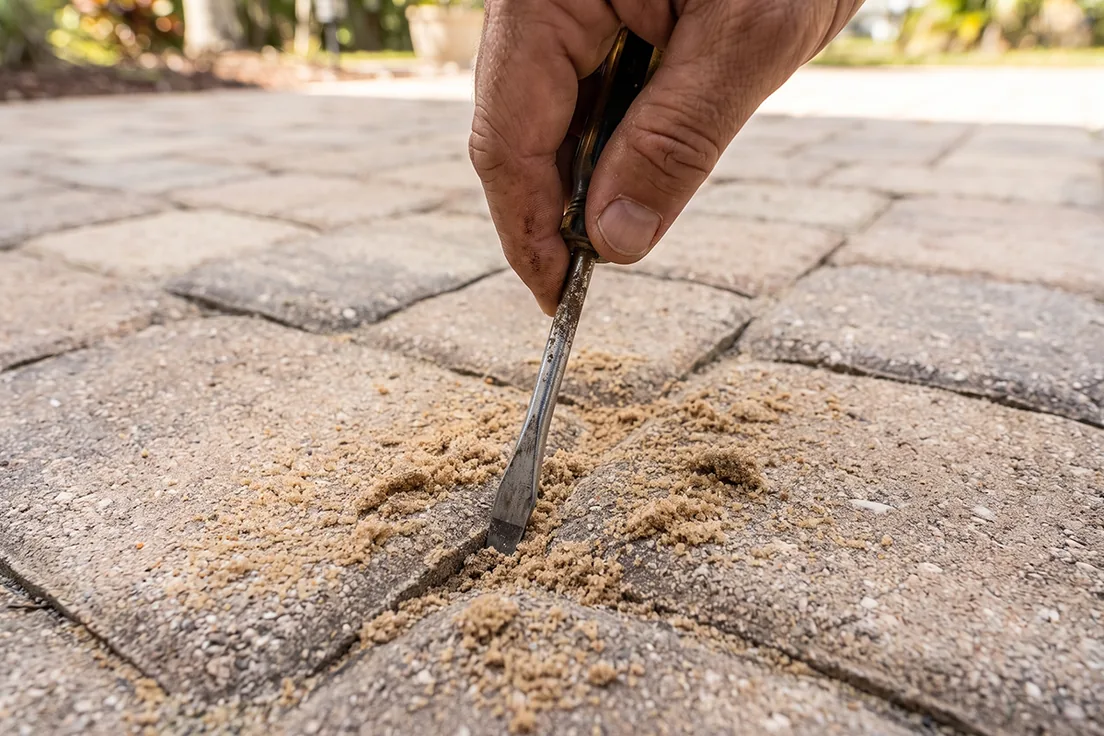
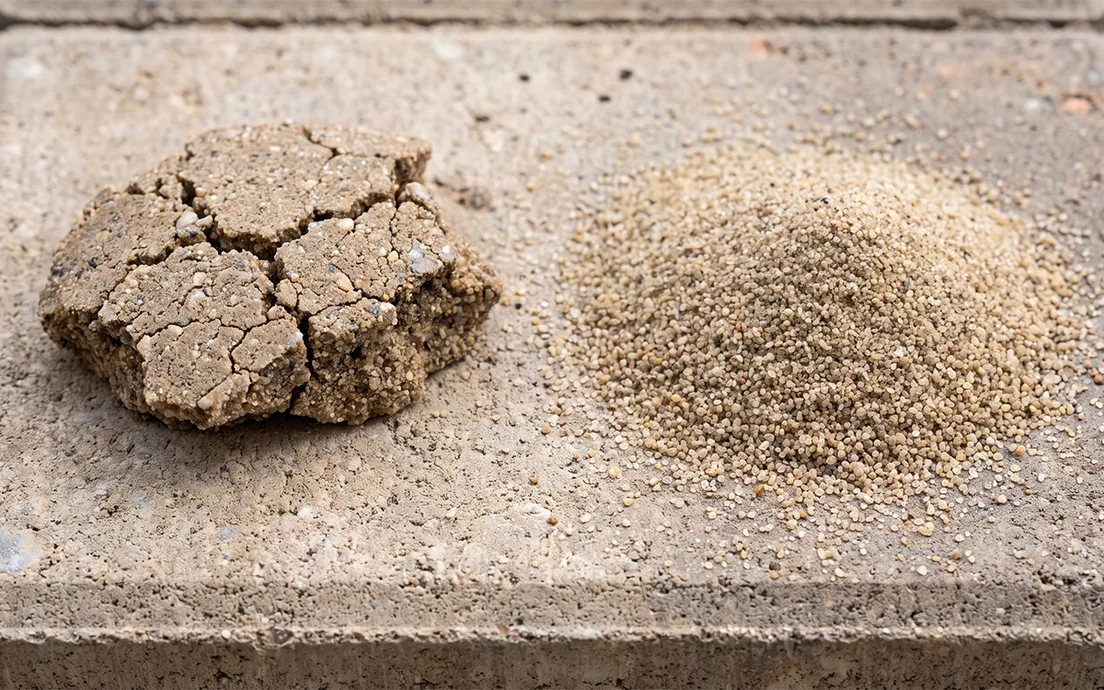
Press the tip of a flathead screwdriver into a joint away from the edge of the surface. Polymer-free sand gives way and you can scratch loose grains out easily. Polymeric sand resists the tip and comes up as hard flakes or a solid crumb, and when it is failing those flakes sit over a hollow void.
Pour a cup of water slowly onto one joint and watch where it goes. Water that soaks straight down through loose grains tells you the joint is polymer free and open. Water that beads, runs along the joint line, or vanishes at one point means either a sealed joint or a cracked polymer joint with a channel underneath.
Look across the surface at a low angle in bright light rather than straight down at your feet. A dull cloudy film following the joint lines out onto the paver faces is polymer haze from an activation that went wrong. A uniform sheen across the whole face is just sealer doing its job.
Yes, and it happens all the time, but only if the polymeric sand is intact and fully cured. Sealing over polymeric sand that has already cracked traps the failure under a film, so we clean and confirm joint condition before sealing a surface with polymer in it.
On a residential Sarasota or Manatee surface, no. A joint-stabilizing sealer over polymer-free sand delivers the joint stability you would be buying polymeric sand for, and it fails gracefully rather than expensively.
It cuts weed growth back for a few years and then loses ground, because weeds in a paver joint germinate in the organic debris that settles on top rather than down in the sand. Regular cleaning does more for weeds across a decade than any joint product does.
Hard flakes that lift out of the joint over an empty void, hairline cracks running along the joint line, and a cloudy film on the paver faces near the joints. Any one of the three means the joint has stopped doing structural work.
It can, and it is the least pleasant part of paver restoration. The hardened material comes out of every joint mechanically, the joint walls get cleaned of residue as thoroughly as the surface allows, and only then can fresh sand and sealer go in.
The sealer, and a pool deck is where the polymeric sand vs sealer distinction matters most, because that surface takes constant water, pool chemistry, and sunscreen. Sealer does the protective work on a porous or soft deck, while the joint only needs to stay full with sand that lets water pass instead of trapping it against the bedding course.
Yes, on both counts. Travertine and marble get cleaned at much lower pressure with chemical assist so the surface is not etched, and they are the materials where a hazing correction carries the most risk, which is one more reason we keep polymer out of their joints. The Natural Stone Institute publishes the standards we follow on soft stone.
We will tell you which sand is in your joints, whether the surface is worth sealing, and what we would do about it, at no charge and with no obligation. It is the same walkthrough behind our 4.9 rating across 420+ reviews.
A crew member walks the surface with you, checks the joints, identifies the paver material, looks for efflorescence and hazing, and tests how the surface takes water. You leave with a written scope for what we would do and why, including the cases where a surface needs nothing.
Paver quotes given over the phone are guesses, because the material, the joint condition, the shade exposure, and whatever the last contractor put in the joints all change the scope. Fifteen minutes on site turns that guess into a number you can hold us to.
Still working out whether your surface needs cleaning, sealing, or both? Our Home Guides library covers the Florida-specific decisions, and soft wash vs pressure wash explains why the cleaning method matters as much as the products that follow it. For service detail, our Sarasota paver cleaning and sealing page goes deeper.